Keyword Mining: How to Systematically Discover New Search Terms with Broad Match — Without Burning Budget
Broad match keywords are a powerful research tool — but without negative keywords, they burn budget. Learn how AI-powered keyword mining automates the sorting process so you only pay for relevant clicks.

Keyword Mining with Broad Match
How to Systematically Discover New Search Terms — Without Burning Budget
Broad match keywords are a powerful tool for keyword research — especially for services and complex offerings that can’t be covered by a handful of exact-match terms. Google serves your ads for related search queries, revealing what potential customers are actually searching for. But this freedom comes at a price.
In this article, we’ll show you why broad match without control becomes a budget trap, how the manual negation process hits its limits, and how AI-powered keyword mining automates the entire workflow.
The Problem with Broad Match: Freedom Without Control
Broad match sounds appealing: a single keyword covers hundreds of related search queries. But that breadth is also the risk. Without active management through negative keywords, Google decides what’s “relevant” — and that assessment is often very generous.
Problem 1: Budget Waste Without Negative Keywords
Without consistent negation, a large portion of your budget flows into irrelevant clicks. A travel provider bidding on “Safari Kenya” suddenly pays for clicks on “Safari browser download” or “Kenya visa application.” The broader the keyword, the more waste — and the faster the daily budget is exhausted without a single relevant click.
Typical broad match campaigns without active negation waste 20–40% of budget on irrelevant search terms. On a monthly budget of €5,000, that’s up to €2,000 thrown away.
Problem 2: The Sorting Problem
The classic workflow for search term evaluation is essentially manual sorting: export the search terms report, go through it line by line, keep relevant terms, add irrelevant ones as negatives. With hundreds of new search terms per week, this becomes a Sisyphean task — especially for agencies running this process for dozens of clients simultaneously.
Problem 3: Growing Complexity
After weeks and months, you end up with dozens of negative keyword lists but no real overview: Which topics are already covered? Are relevant terms accidentally blocked? Do the match types still make sense? Without clear structure and regular review, negative keyword management becomes a risk factor rather than a safeguard.
The Manual Workflow — and Why It Doesn’t Scale
The typical process looks like this: export the search terms report from Google Ads, copy it into a spreadsheet, manually sort by relevance, identify irrelevant terms, create negative keywords and assign them to the right lists. Then hope nothing slips through.
With 50 search terms per week, this is manageable. At 500+, it becomes a full-time job. And with multiple client accounts, it’s simply no longer feasible — at least not with the necessary diligence. The consequence: many advertisers and agencies only check the search terms report sporadically, letting irrelevant clicks run for weeks or months.
Keyword Mining with Firemetrix: AI-Powered Relevance Analysis
Firemetrix automates the entire keyword mining process — from relevance scoring to finished negative keyword lists. Instead of manually reviewing every single search term, an AI-powered analysis handles the evaluation and sorting.
Step 1: Automatic Relevance Scoring
Firemetrix analyzes incoming search terms using AI and the context of your website and landing pages. Each search term receives a relevance score from 0 to 100. The AI automatically recognizes topical fit — no more manual reading and evaluating. A relevance filter lets you instantly see which search terms fall below a certain threshold.
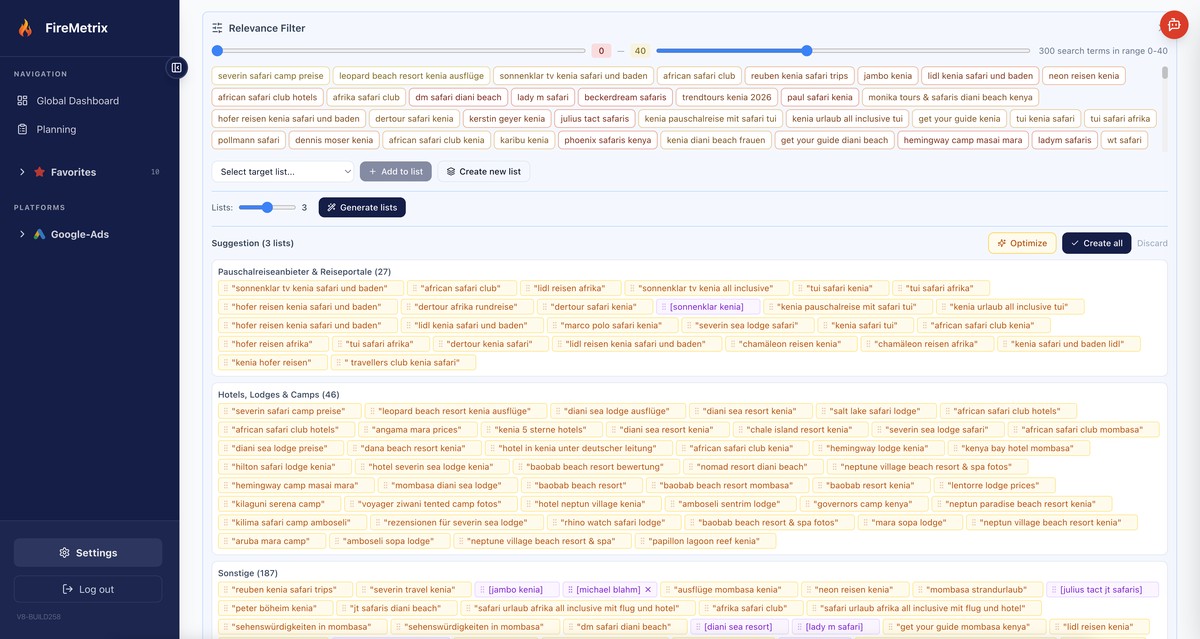
Step 2: Thematically Sorted Negative Keyword Lists
All search terms below a certain relevance threshold — for example under 50% — can be selected and automatically grouped by topic into negative keyword lists. Instead of one endless list, you get clean, thematic lists. For a safari travel provider, Firemetrix automatically generates lists like “Package Tour Operators & Travel Portals,” “Hotels, Lodges & Camps,” and “Miscellaneous.”
Tip: You can control the number of lists to generate and adjust the suggestions before creating them. This way you keep full control over the structure of your negatives.
Step 3: Optimize Match Types
The generated lists can be further optimized. Broad match negatives work well for broad topic exclusions, phrase match for more precise control, and exact match for edge cases where only a very specific term should be blocked. Firemetrix suggests appropriate match types and lets you review and adjust the lists before pushing them to Google Ads.
Step 4: Backtesting — See at a Glance If It Works
Before your negative keyword lists go live, you can use backtesting to visualize how they would have affected your previous search terms. The bubble visualization shows at a glance: blocked search terms on the left, still-active ones on the right. Colors indicate relevance — red for irrelevant, yellow for medium, green for relevant. Bubble size represents click volume.
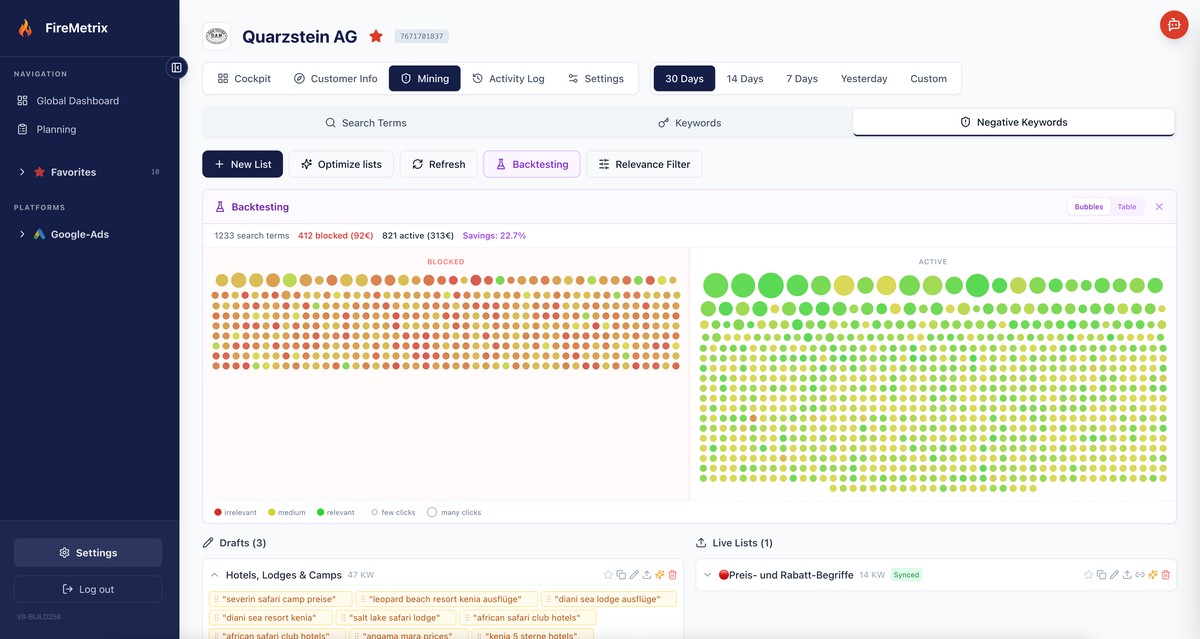
Example: In the screenshot: 1,233 search terms analyzed, 412 blocked (€92 savings), 821 active (€313 relevant spend) — Savings: 22.7% of the previous budget would have been saved.
The Workflow at a Glance
Analyze
AI scores every search term for relevance based on your website
Sort
Irrelevant terms are automatically grouped into thematic lists
Optimize
Adjust match types and list structure to your needs
Test
Backtesting shows the impact before lists go live
Conclusion: Broad Match Isn’t the Problem — Lack of Control Is
Broad match keywords remain one of the best tools for keyword research. They show you what your target audience actually searches for — far beyond what you could come up with on your own. The problem was never broad match itself, but the missing process to separate the wheat from the chaff.
With AI-powered keyword mining, the manual sorting process is automated: score relevance, sort by topic, optimize match types, validate with backtesting. Instead of spending hours in spreadsheets, you spend minutes in a structured workflow — and only pay for clicks that are actually relevant.